고정 헤더 영역
상세 컨텐츠
본문
이 글을 smzzimgril님께 드립니다.
지난 달 전 세계를 떠들썩 하게 했던 소행성의 지구 근접.
소행성이란 무엇이며, 왜 우리에게 두려운 존재인가?
소행성은 태양을 공전하는 작은 천체이다.
행성보다는 작지만 유성체보다는 크다.
혜성과 비교할 때 코마나 꼬리가 보이면 혜성이고,
그것이 없으면 소행성으로 분류한다.
소행성은 작기 때문에 일반적인 천체망원경으로 관측하기란 쉽지 않은 일이다.
현재 발견된 소행성들은 모두 사진을 이용하여 항성과 구분되는 천체를 찾는 방법으로 발견하였다.
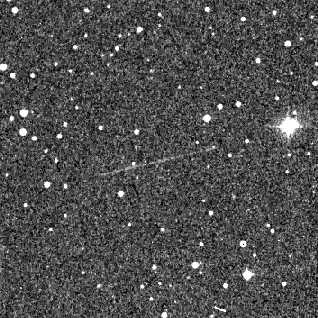
1999 an10
처음 소행성의 존재를 예측한 것은 티티우스, 보데이다.
티티우스와 보데는 물리에 기초한 방법이 아닌
그 당시 발견된 행성들의 거리관계에서 보여지는 상관관계로
천왕성의 존재를 예측하였다.
또한 화성과 목성 사이의 빈 자리에 존재할 천체의 가능성을 예측한 것이다.
이때 발견된 소행성이 Ceres이다.
이후로 약 3000여개의 소행성이 발견되었고, 우리나라에서도 소행성을 발견하였다.
소행성은 티티우스-보데의 법칙에서 예측한 바와 같이
화성과 목성사이에서 공전을 하고 있는 궤도를 가진 천체이다.
이들은 안정된 궤도를 가지고 있고, 안전된 지점에 무리를 이루고 있기도 하다.
하지만 전부가 그런 것은 아니다.
일부는 지구 근처까지 접근하기도 하고,
일부는 튕겨져 나와 지구로 다가오기도 한다.
이런 경우에 소행성은 크기가 작기 때문에 우리가 쉽게 알 수 없다.
그래서 이들 중 지구에 위협이 되는 대상을 NEOs라고 부른다.
Near-Earth Objects의 약자인 NEOs는
근처 행성의 중력에 의해 지구 궤도로 들어오는 혜성 및 소행성을 말한다.
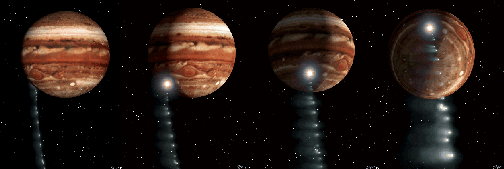
Comet Shoemaker-Levy 9
NEOs도 그 위험도에 따라 몇가지로 분류한다.
| Group | Description | Definition |
|---|---|---|
| NECs | Near-Earth Comets | q<1.3 AU, P<200 years |
| NEAs | Near-Earth Asteroids | q<1.3 AU |
| Atens | Earth-crossing NEAs with semi-major axes smaller than Earth's (named after asteroid 2062 Aten). | a<1.0 AU, Q>0.983 AU |
| Apollos | Earth-crossing NEAs with semi-major axes larger than Earth's (named after asteroid 1862 Apollo). | a>1.0 AU, q<1.017 AU |
| Amors | Earth-approaching NEAs with orbits exterior to Earth's but interior to Mars' (named after asteroid 1221 Amor). | a>1.0 AU, 1.017<q<1.3 AU |
| PHAs | Potentially Hazardous Asteriods: NEAs whose Minimum Orbit Intersection Distance (MOID) with the Earth is 0.05 AU or less and whose absolute magnitude (H) is 22.0 or brighter. | MOID<=0.05 AU, H<=22.0 |
위의 표에서 알 수 있듯이 NEOs는 근일점거리가 1.3AU이내의 혜성과 행성을 말한다.
이 때 혜성과 소행성을 따로 분류하고, 소행성은 Atens, Apollos, Amors로 나눈다.
이들은 지구와 가깝지만 지구에 충돌하기에는 비교적 먼 거리에 있기 때문에
관심의 대상이기는 하지만 지구에 위협을 가하기에는 부족하다.
우리가 관심있게 지켜보아야 할 대상은 PHAs인 것이다.
PHAs는 Potentially Hazardous Asteroids의 약자로 한마디로 위험한 소행성이란 것이다.
하지만 이것이 지구에 부딪힐 것이라는 말이 아니다.
다만 지구에 부딪힐 위험이 있는 그룹이기에 주의깊게 관찰해야 한다는 뜻이다.
PHAs의 그룹에 들기 위해서는 몇가지 조건을 충족시켜야 한다.
지구에 접근하는 최소거리가 7,480,000km 이내, 크기가 150m보다 커야한다.
이 조건을 만족하는 PHAs는 현재 926개이다.
우리는 모든 PHAs의 궤도를 확인할 수도 있다.
향후 약 200년 간 지구-달 거리(LD)의 5배 이내로 접근하는 NEOs는 167개이다.(NASA ; JPL)
이들 중 2029년 0.1LD이내로 접근하는 99942 Apophis에 대해 알아보자.
Apophis 역시 PHAs에 속해있고, 2004 MN4라는 다른 명칭도 가지고 있었다.
(※ 천체에 이름을 붙이는 방식에 있어서 앞의 숫자는 발견된 년도를 나타내고,
뒤의 영문과 숫자는 발견된 순서를 나타낸다.)
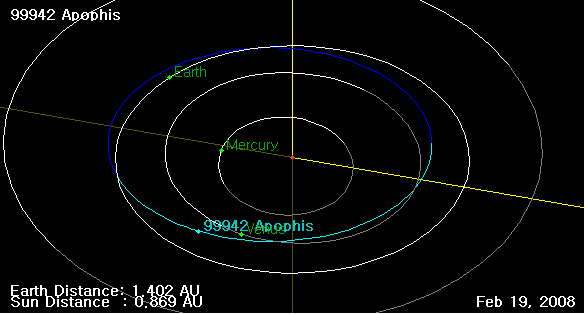
NASA에서는 Apophis를 다음과 같이 주시하고 있었다.
99942 Apophis Discovered 2004 June 19 by R. A. Tucker, D. J. Tholen and F. Bernardi at Kitt Peak.
Also known as Apep, the Destroyer, Apophis is the Egyptian god of evil and destruction who dwelled in eternal darkness. As a result of its passage within 40~000 km of the earth on 2029 Apr. 13, this minor planet will move from the Aten to the Apollo class.
Also known as Apep, the Destroyer, Apophis is the Egyptian god of evil and destruction who dwelled in eternal darkness. As a result of its passage within 40~000 km of the earth on 2029 Apr. 13, this minor planet will move from the Aten to the Apollo class.
만약 Apophis가 지구와 충돌한다면 어떤 일이 벌어질까?
먼저 소행성의 크기에 따른 위력을 살펴보자.
| 크기(km) | 충돌 가능성(년/1회) | 충돌시 발생하는 에너지 | 위력 |
| 0.65 이하 | 6×10⁴ | 104Mt 이하 | 최근 역사에 기록된 자연 재앙과 비슷한 수준으로, 약 104 ~ 105km2 영역에 지진과 화재를 발생시킬 수 있으며, 해일이 발생할 경우 그 피해범위는 더욱 커진다. |
| 1.5 이하 | 3×10⁵ | 104Mt ~ 105Mt | 수분의 급격한 증발로 오존층의 손실 발생 |
| 3 이하 | 2×10⁶ | 105Mt ~ 106Mt | 일산화질소에 의해서 오존층의 자외선 방어 능력이 상실되고, 황과 재로 인해 심각한 기후 변화가 발생 |
| 6.5 이하 | 1.5×10⁷ | 106Mt ~ 107Mt | 먼지와 황산염 증가로 광합성 불가능 |
| - | - | 107Mt 이상 | 106km2이상의 지역에 지진과 폭풍을 발생시키고, 전세계에 걸쳐 해일이 발생하여 홍수를 일으킴 |
| - | - | 109Mt 이상 | 지구상의 바다가 모두 황산화 됨 |
지구 대기를 통과하여 지표면에 도달할 수 있는 최소한의 크기는 50m이다.
Apophis의 경우 그 크기는 270m이다.
지구와 부딪힌다면 지표에 도달할 것이고,
충돌 지점에 충분한 피해가 예상된다.
하지만 Apophis는 정말로 충돌 위험이 있는 것일까?
현재 천문학계에서는 소행성 충돌 위험에 대해서 과장된 경보를 피하고,
현실적인 위험 정도를 나타내기 위해 1999년부터 토리노 척도(Torino Scale)를 사용한다.
Torino Scale은 0부터 10까지 11단계로 구분하고, 색으로 표현된다.
Torino Scale 0도인 흰색은 전혀 충돌 위험이 없다는 뜻이고,
Torino Scale 10도인 붉은색은 지구에 큰 위험을 불러일으킬 수 있다는 뜻이다.
| THE TORINO IMPACT HAZARD SCALE |
Assessing Asteroid And Comet Impact Hazard Predictions In The 21st Century
| No Hazard (White Zone) |
0 |
The likelihood of a collision is zero, or is so low as to be effectively zero. Also applies to small objects such as meteors and bodies that burn up in the atmosphere as well as infrequent meteorite falls that rarely cause damage. |
| Normal (Green Zone) |
1 |
A routine discovery in which a pass near the Earth is predicted that poses no unusual level of danger. Current calculations show the chance of collision is extremely unlikely with no cause for public attention or public concern. New telescopic observations very likely will lead to re-assignment to Level 0. |
| Meriting Attention by Astronomers (Yellow Zone) |
2 |
A discovery, which may become routine with expanded searches, of an object making a somewhat close but not highly unusual pass near the Earth. While meriting attention by astronomers, there is no cause for public attention or public concern as an actual collision is very unlikely. New telescopic observations very likely will lead to re-assignment to Level 0. |
3 |
A close encounter, meriting attention by astronomers. Current calculations give a 1% or greater chance of collision capable of localized destruction. Most likely, new telescopic observations will lead to re-assignment to Level 0. Attention by public and by public officials is merited if the encounter is less than a decade away. | |
4 |
A close encounter, meriting attention by astronomers. Current calculations give a 1% or greater chance of collision capable of regional devastation. Most likely, new telescopic observations will lead to re-assignment to Level 0. Attention by public and by public officials is merited if the encounter is less than a decade away. | |
| Threatening (Orange Zone) |
5 |
A close encounter posing a serious, but still uncertain threat of regional devastation. Critical attention by astronomers is needed to determine conclusively whether or not a collision will occur. If the encounter is less than a decade away, governmental contingency planning may be warranted. |
6 |
A close encounter by a large object posing a serious but still uncertain threat of a global catastrophe. Critical attention by astronomers is needed to determine conclusively whether or not a collision will occur. If the encounter is less than three decades away, governmental contingency planning may be warranted. | |
7 |
A very close encounter by a large object, which if occurring this century, poses an unprecedented but still uncertain threat of a global catastrophe. For such a threat in this century, international contingency planning is warranted, especially to determine urgently and conclusively whether or not a collision will occur. | |
| Certain Collisions (Red Zone) |
8 |
A collision is certain, capable of causing localized destruction for an impact over land or possibly a tsunami if close offshore. Such events occur on average between once per 50 years and once per several 1000 years. |
9 |
A collision is certain, capable of causing unprecedented regional devastation for a land impact or the threat of a major tsunami for an ocean impact. Such events occur on average between once per 10,000 years and once per 100,000 years. | |
10 |
A collision is certain, capable of causing global climatic catastrophe that may threaten the future of civilization as we know it, whether impacting land or ocean. Such events occur on average once per 100,000 years, or less often. |
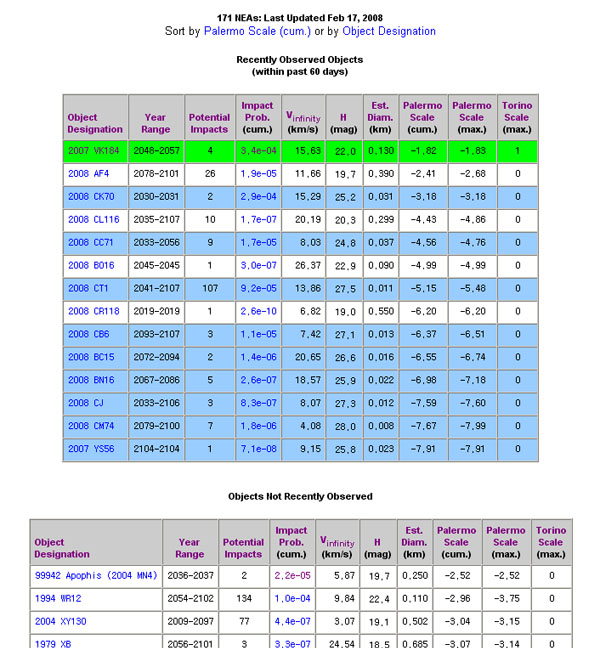
이 Torino Scale에 따르면 Apophis는 위험이 없는 0도를 나타낸다.
좀 더 자세히 수치로 나타내면 충돌가능성은 0.002200000%.
다시 말해 1/45,000의 확률이다.
다른 PHAs들도 거의 흰색을 나타내고 있으며,
단지 얼마전 발견된 2007 VK184만이 녹색을 보이고 있다.
(※ 아마도 발견된지 얼마 되지 않았기 때문이라고 조심스럽게 예상해 본다.)
과학자들이 추측하는 바에 의하면 지구 생명의 기원은 소행성의 충돌로 인한 유기물의 공급이라고 한다.
또한 지구를 주름잡던 공룡의 멸망도 소행성 또는 혜성을 충돌에 의한 것이라고 여겨진다.
언제, 어디서 날아올지 모르는 작은 천체가 지구에 생명을 주기도 하고 생명을 위협할 수도 있다.
하지만 아직까지 일반인들이 우주로부터의 위협을 걱정하는 것은 기우가 아닐까 생각해본다.
그리고 위험이 닥치면 그것을 해결할 수 있는 능력을 가진 것 또한 인간이 아니던가?
그리고 위험이 닥치면 그것을 해결할 수 있는 능력을 가진 것 또한 인간이 아니던가?
일반인들이 우주에 대해 가지고 있는 호기심과 두려움을 이용해서
잘못된 정보를 가지고 이야깃거리를 만들고 미래를 걱정하게 하는 사람들이 있다.
우리는 두려움이 앞서기 보다는 조금 더 생각해 보고, 현재에 충실하고, 미래에 대한 계획을 세울 수 있는
인간다운 자세가 필요할 것 같다.
잘못된 정보를 가지고 이야깃거리를 만들고 미래를 걱정하게 하는 사람들이 있다.
우리는 두려움이 앞서기 보다는 조금 더 생각해 보고, 현재에 충실하고, 미래에 대한 계획을 세울 수 있는
인간다운 자세가 필요할 것 같다.
반응형
'별보기 > 우주 이야기' 카테고리의 다른 글
| 우리에겐 너무 소중한 하나뿐인 별 「태양」 (0) | 2008.07.16 |
|---|---|
| 과거로의 시간여행 (0) | 2008.06.24 |
| Apollo 11호는 정말 달에 착륙하였을까? (29) | 2007.11.24 |
| 지구를 위협하는 작은 천체들 NEOs (2) | 2007.10.01 |
| 외계 행성 찾는 방법 (0) | 2007.06.25 |


